Basic Genetics Mini Research Poster
Epigenetic Editing in Complex Diseases: Targeted DNA methylation/histone
modifications using dCas9 without altering the underlying sequence
Introduction/Background (80-100 words)
- Briefly explain the genetic principle (e.g., Mendelian inheritance, DNA repair, genetic mapping).
- Define key terms to ensure accessibility for peers.
Key Findings / Research Evidence (150-200 words)
- Summarize at least 2-3 research studies, discoveries, or landmark experiments.
- Highlight results relevant to the chosen topic (e.g., Mendel's pea plant experiments modern genetic counselling; Human Genome Project personalized medicine).
Applications in Biomedicine/Biotechnology (100-150 words)
- Clearly link the genetic concept to practical uses Examples: Genetic screening in public health. Recombinant insulin in biotechnology. CRISPR in treating sickle cell anaemia.
- Include benefits, limitations, and potential ethical considerations.
Visual Elements (mandatory)
- Minimum of 2 diagrams/figures/tables to illustrate your points.
- Examples: pedigree chart, chromosome map, schematic of DNA replication, infographic on Hardy-Weinberg equilibrium.
- Images should preferably be self-designed or taken from credible sources (with citation).
Conclusion (2-3 bullet points)
- Summarize the genetic principle, its biomedical application, and future potential.
References
- At least 5 scientific references (textbooks, journal articles, or credible sources).
- Format: APA 7th edition.
Introductions & Background
(Jin, G., & Lim, B. (2022). Epigenome editing and epigenetic gene regulation in disease phenotypes. Korean Journal of Chemical Engineering, 39(6), 1361-1367.
Epigenetic modifications refer to physical and conformational changes to the genome that affect gene expression without altering DNA sequences. These changes include DNA methylation and post-translational modifications on histones via methylation, acetylation, phosphorylation, etc.)
- Syding, L. A., Nickl, P., Kasparek, P., & Sedlacek, R. (2020). CRISPR/Cas9 epigenome editing potential for rare imprinting diseases: a review. Cells, 9(4), 993.
- FRATNOW. (n.d.). Developmental origins of health and disease: Epigenetics, nutrition, and infant health. https://autism.fratnow.com/blog/developmental-origins-of-health-and-disease-epigenetics-nutrition-and-infant-health/
(Epigenetics, literal translation “on top of the genetics”, involves mechanisms of gene regulation without changing the DNA sequence. The most critical processes participating in gene regulation are DNA methylation, histone modification, and chromatin remodeling.
DNA methylation is based on the enzymatic addition of a methyl group to cytosine.
Another regulatory process is histone modification, which involves chemical alternations on unstructured ends of histone proteins. Histone modification, essential for gene regulation, is conferred by methylation and acetylation on histones located in the vicinity of promoters or enhancers.
TETs, in combination with dCas9, have been used for demethylation leading to decondensation of chromatin and subsequent binding of transcription factors.” This indirectly explains one consequence of chromatin remodeling: when chromatin becomes less condensed, transcription factors can access DNA more easily (Chromatin remodeling refers to changes in how tightly DNA is packaged around histone proteins. When chromatin is open or decondensed, transcription factors can access genes more easily and gene expression may increase; when it is tightly packed, genes are less accessible and may be silenced (Syding et al., 2020)))
🟩 Epigenetics refers to gene regulation without changing the DNA sequence. Gene regulation includes DNA methylation which adds methyl groups to cytosine, histone modification that involves chemical changes on histone proteins, and chromatin remodeling which changes how tightly DNA is packaged around histones where less condensed chromatin allows transcription factors to bind to DNA more easily (Syding et al., 2020). Epigenetic editing uses dCas9, a nuclease-inactive Cas9, guided by RNA to specific DNA sites. As dCas9 does not cut DNA, it can deliver enzymes that add or remove methylation or histone marks, precisely regulating gene expression, treating imprinting disorders such as Angelman and Prader-Willi (Syding et al., 2020).

Figure 1. An overview of epigenetic mechanisms. (a) DNA methylation, (b) histone (H2A, H2B, H3, and H4) modification From Developmental Origins of Health and Disease: Epigenetics, Nutrition, and Infant Health, by FRATNOW, n.d. (https://autism.fratnow.com/blog/developmental-origins-of-health-and-disease-epigenetics-nutrition-and-infant-health/). Copyright by FRATNOW.
(100 words)
Key Findings / Research Evidence
(Liu et al. demonstrated precise epigenetic editing in mammalian genomes using a programmable dCas9 platform fused to the catalytic domains of DNA methyltransferases (Dnmt3a) or demethylases (Tet1). Without modifying the underlying sequence, dCas9-Tet1 demethylated the BDNF promoter and MyoD enhancer, actively restoring gene expression and boosting cellular reprogramming. Conversely, dCas9-Dnmt3a targetedly hypermethylated CTCF loop anchor sites, blocking CTCF binding and altering 3D chromatin architecture to regulate downstream genes. This foundational study validates that targeted DNA methylation editing can directly manipulate chromatin structure and gene networks, offering a powerful blueprint for epigenetic therapeutics in complex diseases.)
🟩 Liu et al., (2016) engineered programmable dCas9 platforms to bidirectionally edit mammalian DNA methylation without altering the underlying sequence. The study shows how the demethylation of the BDNF promoter IV can be actively induced using a dCas9-Tet1 fusion protein together with specific gRNAs, leading to the targeted activation of BDNF expression in post-mitotic neurons. Conversely, targeted gene silencing is achieved using a dCas9-Dnmt3a fusion to deposit de novo methylation at unmethylated promoter CpG sites, directly blocking the transcription machinery to shut off gene expression with an optimized inactivation efficiency of up to 70%. This demonstrate how scientists can reliably both activate and silence gene activity without altering the underlying genetic code.
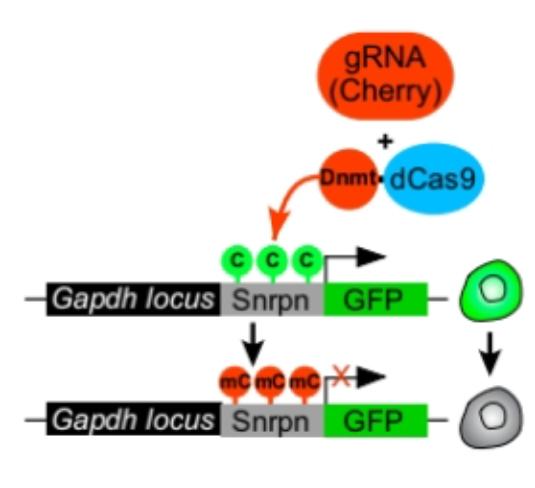
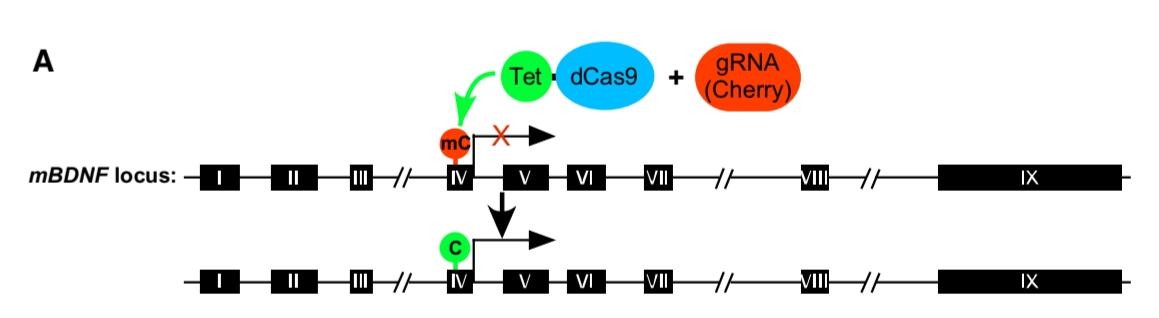
Figure 4. Targeted demethylation of the BDNF promoter IV induced by dCas9-Tet1 fusion protein with specific gRNAs. From "Editing DNA Methylation in the Mammalian Genome," by X. S. Liu et al., 2016, Cell, 167(1), p. 238. CC BY 4.0.
Nuñez et al., (2021) expanded this by proving the permanent, long-term gene control without altering the underlying sequence or causing double-strand breaks is achievable through the CRISPRoff system. A single dead Cas9 fusion links KRAB, DNMT3A, and DNMT3L to program durable and long term gene silencing. A transient exposure to the editor deposits localized H3K9me3 histone marks and CpG DNA methylation. This brief treatment establishes an epigenetic memory that silences targeted genes for more than 450 cell divisions and remains completely stable even through the differentiation of stem cells into neurons, proving that permanent transcriptional memory requires absolutely no genomic sequence modifications.


Ultimately, this proves how epigenetic modifications enables permanent, genomic sequence-independent control of gene activity that stably persists through more than 450 future cell generations.
(235 words)
-
Liu, X. S., Wu, H., Ji, X., Stelzer, Y., Wu, X., Czauderna, S., Shu, J., Dadon, D., Young, R. A., & Jaenisch, R. (2016). Editing DNA methylation in the mammalian genome. Cell, 167(1), 233–247. doi.org
-
Nuñez, J. K., Chen, J., Pommier, G. C., Cogan, J. Z., Replogle, J. M., Adriaens, C., Ramadoss, G. N., Shi, Q., Hung, K. L., Samelson, A. J., Pogson, A. N., Kim, J. Y. S., Chung, A., Leonetti, M. D., Chang, H. Y., Kampmann, M., Bernstein, B. E., Hovestadt, V., Gilbert, L. A., & Weissman, J. S. (2021). Genome-wide programmable transcriptional memory by CRISPR-based epigenome editing. Cell, 184(9), 2503–2519. doi.org
Applications in Biomedicine/Biotechnology
-
Toma, L., Barbălată, T., Hărătău, J. I. C., Sanda, G. M., Fuior, E. V., Fenyo, I. M., Socol, A., & Stancu, C. S. (2026). CRISPR/dCas9-induced upregulation of endogenous apolipoprotein A1 and paraoxonase 1 genes reduces the aortic lipid deposits in apoE−/− mice. Molecular Biomedicine, 7(1), Article 176. https://doi.org/10.1186/s43556-026-00580-8
-
Park, M., Ryu, H., Heo, S., Kim, B., Park, J., Lim, K. H., Kim, J., & Park, H. (2025). Targeted demethylation of cathepsin D via epigenome editing rescues pathology in Alzheimer's disease mouse model. Theranostics, 15(2), 428–438. https://doi.org/10.7150/thno.103455
🟩 Targeted dCas9 for epigenetic editing applications in Biomedicine or Biotechnology helps with precise gene-regulatory mechanisms for complex diseases without inducing permanent DNA damage. For cardiovascular therapeutics, Toma et al., (2026) used dCas9 fused with a VP64 activation domain to target Apoa1 and Pon1 genes in apoE-/- Mice. This boosts Apolipoprotein A1 production and circulating HDL in the blood stream. By driving up hepatic expression and systemic secretion of Apolipoprotein A1, it enhances HDL functionality by stimulating reverse cholesterol transport via the liver and lower endothelial inflammatory markers like VCAM-1 and MCP-1. Ultimately, this gene-activation strategy led to a dramatic decrease in plaque buildup and lipid deposits in the thoracic aorta and aortic root.


Conversely, in Alzheimer's disease, Park et al., (2025) fused dCas9 to TET1 to remove repressive methylation marks and significantly boost endogenous Ctsd expression by targeting endogenous Apoa1 and Pon1 genes in apoE-/- mice. This restores Cathepsin D lysosomal protease production which accelerates the clearance of toxic amyloid-beta plaques as well as reversing cognitive deficits. Rather than blunt-force overexpression of complementary DNA, these applications demonstrate how epigenetic editing in complex diseases using dCas9 without altering the underlying sequence can be safe and precise across different medical fields.

Figure 8. A schematic diagram showing the mechanism of the dCas9-Tet1 system. From "Targeted demethylation of cathepsin D via epigenome editing rescues pathology in Alzheimer's disease mouse model," by M. Park et al., 2025, Theranostics, 15(2), p. 432. CC by 4.0.
Conclusion
-
Genetic & Epigenetic Mechanisms: Targeted DNA methylation or histone modifications using dCas9 can be used for treating complex diseases in the biomedical and biotechnological sectors
-
Future Translational Potential: provides a non-mutagenic framework for durable, cell-heritable therapeutics, opening broad avenues for non-cleaving epigenome therapies as delivery systems continue to advance.
