Cyclins & CDK
related to cell cycle checkpoints and Tumor suppressor genes
-
What is a Kinase? ( Phosphorylated protein concept ) Let's start with the word kinase. A kinase is simply a type of enzyme. Its only job in biology is to perform a chemical reaction called phosphorylation. Phosphorylation: The kinase grabs a cellular energy molecule (ATP), breaks off a phosphate group, and physically attaches it to a specific target protein. Why it matters: Phosphate groups are bulky and carry a strong negative charge. When a kinase forces a phosphate onto a target protein, the target protein has to physically change its 3D shape to accommodate it. This shape-change acts like a molecular switch—it instantly turns the target protein "on" (or "off") so it can do its job.
-
What is a CDK? CDK stands for Cyclin-Dependent Kinase. As the name tells you, it is a kinase (an enzyme that attaches phosphates to flip molecular switches). But it is cyclin-dependent. By itself, a CDK is completely inactive. It floats around in the cell, fully built, but turned off. It cannot phosphorylate anything until a second protein binds to it and wakes it up.
-
What is a Cyclin? A Cyclin is the activator protein that turns the CDK on. Unlike CDKs (which are always present in the background), cyclins are only synthesized when the cell is actually ready to move to the next phase. Their concentration cycles—the cell builds them up rapidly when needed, and destroys them as soon as their specific phase is over.
Putting It All Together
- Here is exactly how these molecules interact to drive a cell forward:
- The cell is in the G1 phase (growing) and is preparing to copy its DNA (S phase).
- The cell builds a specific Cyclin (e.g., Cyclin E).
- Cyclin E binds to a CDK (CDK2) that is already floating nearby.
- The newly formed Cyclin E-CDK2 complex is now active.
- Because the CDK is now active, it acts as a kinase: it runs around phosphorylating specific target proteins.
- Those target proteins change shape, turn "on," and begin the actual physical work of replicating the DNA.
- Once the DNA replication process successfully begins, the cell destroys Cyclin E. The CDK turns back off, and the process pauses until the next phase is ready.
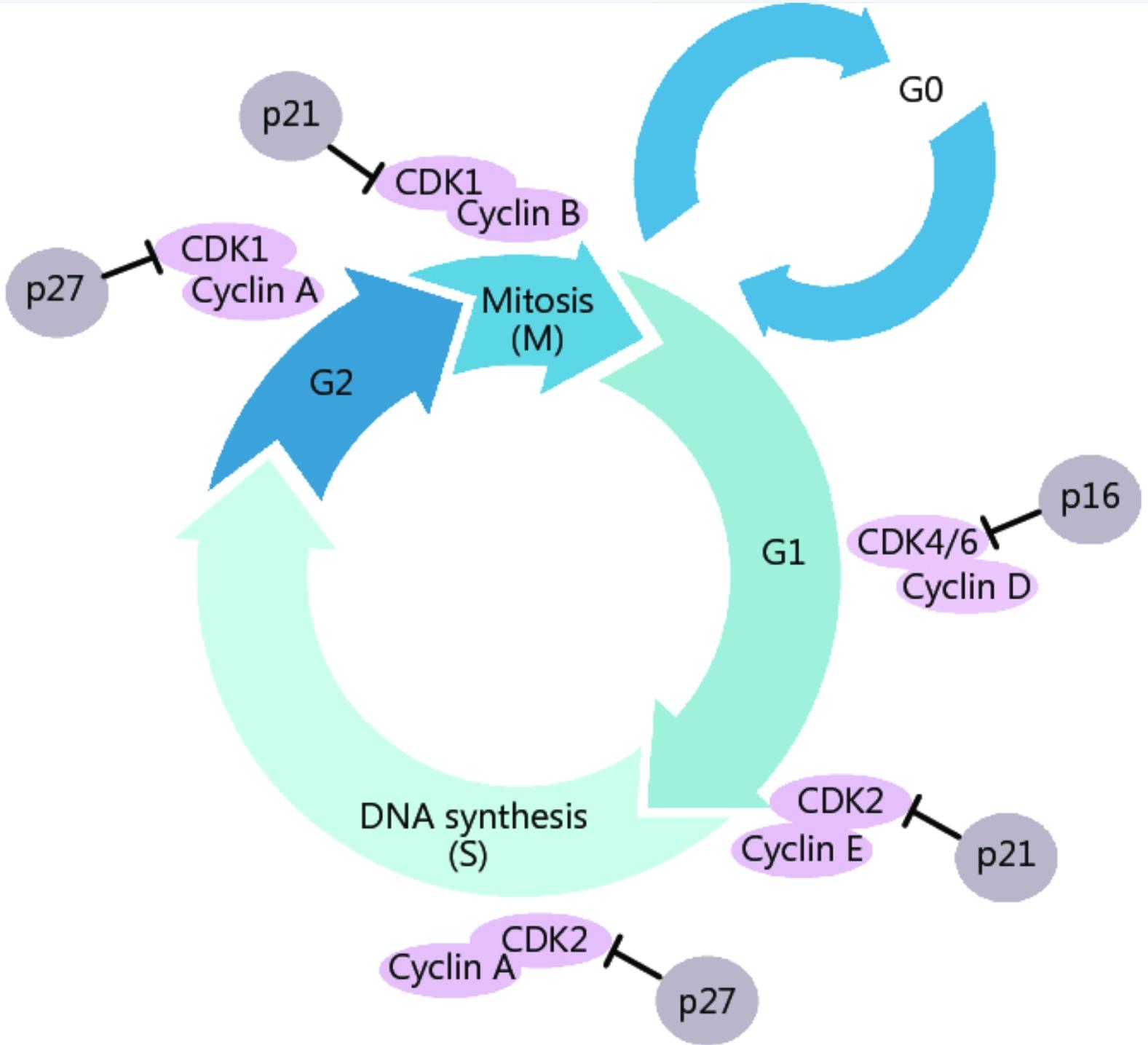
The Phases & Their Drivers G1 Phase (Growth & Prep): The cell grows and checks if the environment is safe to divide. Cyclin D pairs with CDK4 and CDK6 to start the process, acting as the initial push.
S Phase (DNA Synthesis): The cell must perfectly copy its entire DNA blueprint. Cyclin E + CDK2 fires the "starting gun" for DNA replication, while Cyclin A + CDK2 keeps the copying machinery running smoothly.
G2 Phase (Final Checks): The cell double-checks the newly copied DNA for errors. Cyclin A + CDK1 prepares the physical structures needed to pull the cell apart.
M Phase (Mitosis): The cell physically splits in two. Cyclin B + CDK1 forms a powerful complex (MPF) that breaks down the nucleus and condenses chromosomes for the final split.
Checkpoints and Cancer The Rb Protein (The Gatekeeper): Rb normally blocks the cell from copying its DNA prematurely.
The Cyclin D-CDK4/6 engine phosphorylates Rb. This shape-change forces Rb to let go of the DNA-copying machinery, allowing the cell cycle to proceed into the S Phase.
Inhibitors (The Emergency Brakes): If the cell detects damaged DNA, it produces inhibitor proteins (like p21, p27, or p16). These wedge themselves directly into the Cyclin-CDK complexes, jamming the engines and halting the cell cycle until the DNA is repaired.
Targeted Cancer Therapy: In many cancers, the Cyclin D-CDK4/6 engine is permanently stuck in the "on" position, causing explosive tumor growth. Modern targeted drugs (like palbociclib or ribociclib) are chemically designed to plug up the CDK4/6 engines, shutting down the rogue assembly line without indiscriminately killing healthy cells.
