Tumor suppressor genes
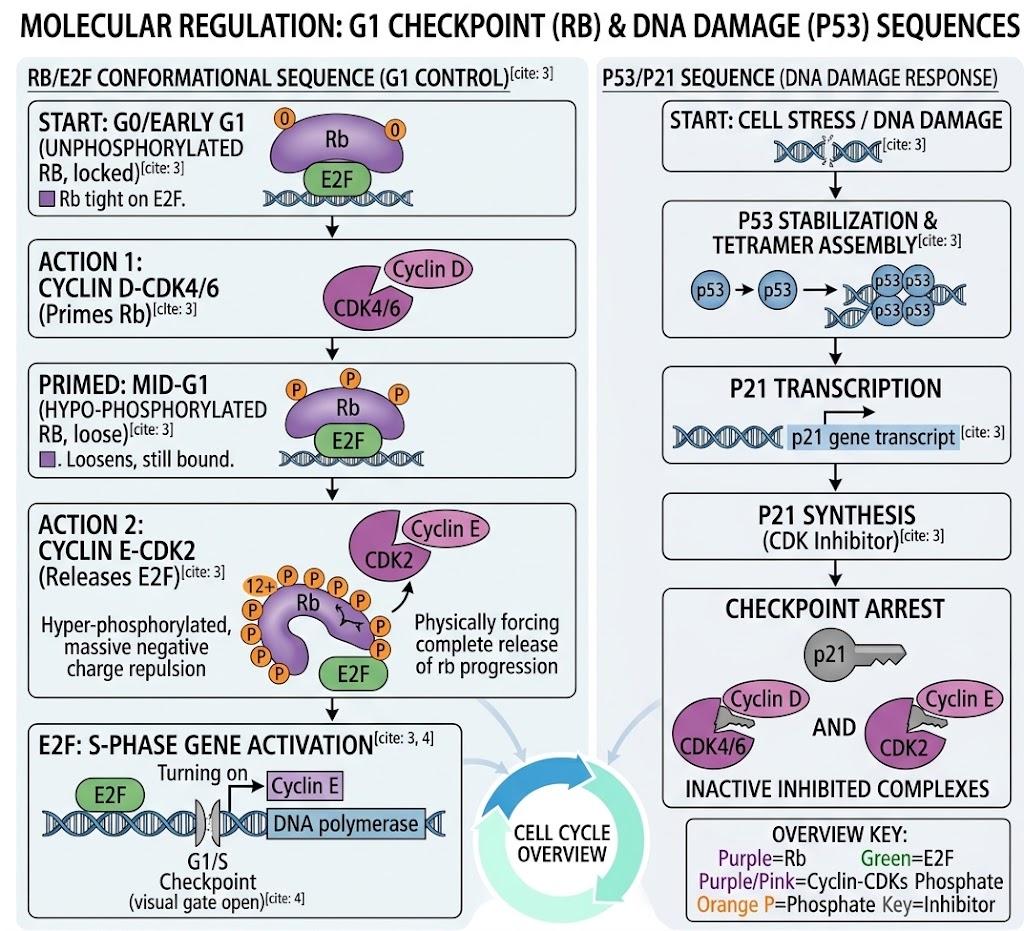
Tumor suppressor genes act as the cell's internal brake system. While Cyclins and CDKs act as the "gas pedal" pushing the cell cycle forward, tumor suppressors like p53 and Rb ensure the cell only divides when it is healthy and environment conditions are right.
1. Rb (Retinoblastoma Protein) — The Gatekeeper at G1/S
Rb acts as a molecular padlock that physically holds the cell in the G1 phase until the cell is big enough and ready to replicate its DNA.
- How it works: Rb binds to and inhibits a critical protein called E2F. E2F is a transcription factor needed to turn on the genes that replicate DNA in the S phase. As long as Rb is bound to E2F, the cell cannot enter S phase.
- How CDKs turn it off: When the cell receives signal to divide, Cyclin D-CDK4/6 and Cyclin E-CDK2 phosphorylate Rb.
- The Switch: Adding those negative phosphate groups changes Rb's 3D shape, forcing it to release E2F. Unbound E2F immediately activates DNA synthesis genes, passing the G1/S checkpoint.
- In Cancer: If the gene encoding Rb is mutated or lost, E2F is permanently free. The cell loses its primary G1 checkpoint gatekeeper and continually rushes into DNA replication. cell cycle checkpoints
2. p53 — The "Guardian of the Genome" & Control of p21
p53 is a master transcription factor that monitors DNA integrity and cellular stress. It connects directly to the p21 inhibitor shown in your cell cycle diagram.
- How it works: Under normal conditions, p53 levels remain low. However, if the cell detects broken or damaged DNA, p53 becomes activated and stabilizes.
- Action 1: Halting the Cell Cycle (via p21):
- Activated p53 binds to DNA and turns on the gene for p21.
- The cell produces p21, which acts as a direct CDK inhibitor (as shown in the gray circles of the diagram).
- p21 wedges into CDK2 and CDK1 complexes, freezing the cell cycle at the G1/S or G2/M checkpoints.
- This pause gives the cell's repair enzymes time to fix the damaged DNA before it gets copied or divided.
- Action 2: Apoptosis (Programmed Cell Death): If the DNA damage is too severe to fix, p53 gives up on repair and turns on pro-apoptotic genes (like BAX and PUMA). This triggers programmed cell death, sacrificing the cell to prevent a damaged genome from causing cancer.
- In Cancer: p53 is mutated or inactivated in over 50% of all human cancers. Without functional p53, p21 is not produced when DNA is damaged, damaged DNA gets replicated, and mutated cells multiply without undergoing apoptosis.
