allosteric modulators
Binding Location and Mechanism
-
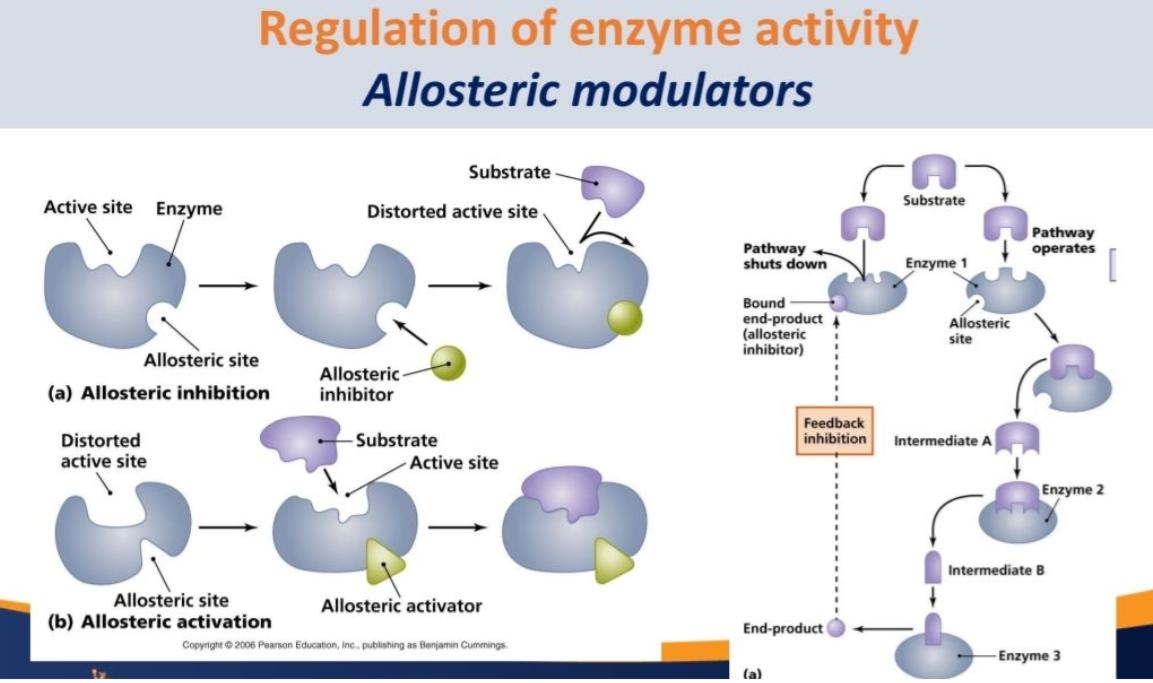
Allosteric Modulators: These molecules attach to an allosteric site (a location other than the active site). They cause a conformational (shape) change in the protein. This change can be negative (inhibiting activity) or positive (activating and enhancing activity).
-
Competitive Inhibitors: These molecules mimic the substrate and bind directly to the active site. They physically block the substrate from entering
Effect of Substrate Concentration
-
Allosteric Modulators: Adding more substrate cannot overcome allosteric inhibition because the inhibitor does not compete for the active site. Similarly, allosteric activators boost efficiency regardless of direct site competition.
-
Competitive Inhibitors: Adding a high concentration of substrate can overcome competitive inhibition. The large number of substrate molecules outcompetes the inhibitor for the active site.
Allosteric inhibition disables the active site through a domino-effect process known as conformational change.
Enzymes are not rigid shapes; they are dynamic, flexible proteins held together by chemical bonds. Because the allosteric site and the active site are physically linked through the enzyme's shared protein backbone, an impact at one site directly warps the other.
The step-by-step mechanical breakdown explains how this occurs:
1. The Inhibitor Binds and Alters Local Bonds
When an allosteric inhibitor docks into the regulatory (allosteric) site, its atoms interact with the amino acids in that specific pocket via hydrogen bonds, ionic bonds, or hydrophobic interactions. This forces the local section of the protein to shift or twist to accommodate the inhibitor molecule.
2. A Structural "Domino Effect" propagates
Proteins are tightly folded, interconnected chains of amino acids. As the allosteric pocket moves, it pulls and pushes on adjacent amino acid loops. This chemical tension cascades through the body of the enzyme like a wave, eventually reaching the distant active site.
3. The Active Site Distorts
Once the structural wave hits the active site, its physical architecture is forced to warp. This distortion typically takes one of two forms:
- Steric Blockage or Collapse: The active site loops might fold inward, narrowing the pocket or collapsing it entirely so the substrate can no longer physically fit.
- Chemical Misalignment: The shape might alter just enough that the crucial catalytic amino acids inside the pocket move away from where they need to be. Even if the substrate manages to touch the active site, the enzyme can no longer form the proper chemical bonds required to trigger the reaction.
4. Transition to the "Tense" State
In multi-subunit enzymes, allosteric inhibitors usually lock the enzyme into what biochemists call the T-state (Tense state). In this structural state, the subunits tightly grip each other, reducing flexibility and keeping the active sites rigidly deformed and non-functional.
Once the concentration of the inhibitor drops, the molecule detaches from the allosteric site, allowing the protein to snap back into its natural, active R-state (Relaxed state).
Would you like to explore a specific real-world example of this process, such as how ATP acts as an allosteric inhibitor in glycolysis, or look at how this changes the Michaelis-Menten velocity curves?
so for allosteric activation the active site distorts which fits the shape of the substrate in contrast to allosteric inhibitation
