L1 - Human Physiology
🧠 Concepts Introduced
LIST
FROM "00 Archive/Objects/Concepts"
WHERE lecture = this.file.link
Definitions
Anatomy definition: study of structures associated with human body (organelle, cells, tissues, organs & organisms)
Physiology definition: study of functionality of living organisms at the cellular, organ & systemic level - relating structure & function
Levels of organisation:
-
subatomic particle - proton, neutron, electron
-
atomic
-
molecule
-
macromolecule - carbohydrate, protein, nucleic acid, lipid
-
organelle
-
cell
-
tissue
-
organ
-
system
-
organism
Organ systems:
-
Integumentary system skin: acts as a barrier against the external environment as 1st line of barrier sweat glands
-
Skeletal system & Muscular system movement, structure support
-
Nervous system & Endocrine system control responses ( brain & spinal cord) action potential important for regulation C2 hormones
-
Cardiovascular system & Lymphatic system
-
Digestive system & Respiratory system & Urinary system
-
Male & Female reproductive system hormones

Internal & External Environment
External environment - temperature, humdity etc.
Internal environment - body temperature, blood pH, water balance, CO2
Intracellular fluid
- inside cells
- not part of internal environment
Extracellular fluid
- fluid surrounds cells
- part of internal environment
- plasma & interstitial fluid
Homeostasis
the process of maintaning a relatively stable internal environment regardless of changing external environment - it's not a static state of balance but a continuous dynamic response receptor -> integrator -> effector
-
Stimulus produces change in variable
-
change is detected by receptor
-
information is sent along afferent pathway to control centre
-
Information is sent along efferent patheay to effector
-
response of effector feeds back to influence magnitude of stimulus and returns variable to homeostasis
negative feedback - opposes stimulus to stabilise the regulated variable
positive feedback - reinforces stimulus and sends the regulated variable even farther from its normal value
Basic Unit of life - cells & Organelles
characteristics of cells:
-
general cell structure & components
-
general mechanisms for changing nutrients to energy
-
deliver end products into their surrounding fluid
-
almost all have the ability to reproduce
cell structure:
-
plasma (cell) membrane
-
cytoplasm & organelles
-
cytosol
-
membranous organelles: mitochondria endoplasmic reticulum golgi complex lysosomes peroxisomes
-
inclusions - lipid droplets - glycogen granules - ribosomes - caults - proteasomes - cytoskeleton - centrioles - centrosome - cilia - flagella
-
-
nucleus

4 Classes of Biomolecules + Functions
- carbohydrates -glucose fructose galactose - sucrose lactose maltose - starch cellulose glycogen

-
proteins - has 4 levels of protein structure structural protein storage proteins contractile proteins transport proteins
-
lipids - carbon & hydrogen -tryglycerides (glycerol, fatty acid chains for energy storage) - phospholipids (membranes) - steroids (membranes / hormones) - eicosanoids (signaling molecules)

- nucleotides DNA & RNA store genetic material tranmit & store energy - composition of base, sugar (carbohydrate) & phosphate groups
Energy in biological systems
energy - defined as the ability to do work
types of work in biological systems: - chemical (forming & breaking chemical bonds - storing & releasing energy) - transport (movement of substances across a concentration gradient - plasma membrane) - mechanical (movement of organelles, cells changing shape, muscle contractions, etc.)
kinetic energy - energy of motion (chemical, transport, mechanical)
potential energy - stored energy (concentration gradient, chemical bonds)
energy converted from one form to another is never a 100% efficiet conversion
Activation Energy
initial input of energy into reactants to initiate a chemical reaction
endergonic reaction - exergonic reaction
anabolic pathway:
- synthesizing large molecules
- require input of energy
catabolic pathway:
- large molecules broke down to smaller molecules
- release energy that can be used for work
Function of enzymes
biological catalysts
lower activation energy
specific enzyme bind to specific targets form enzyme - substrate complex

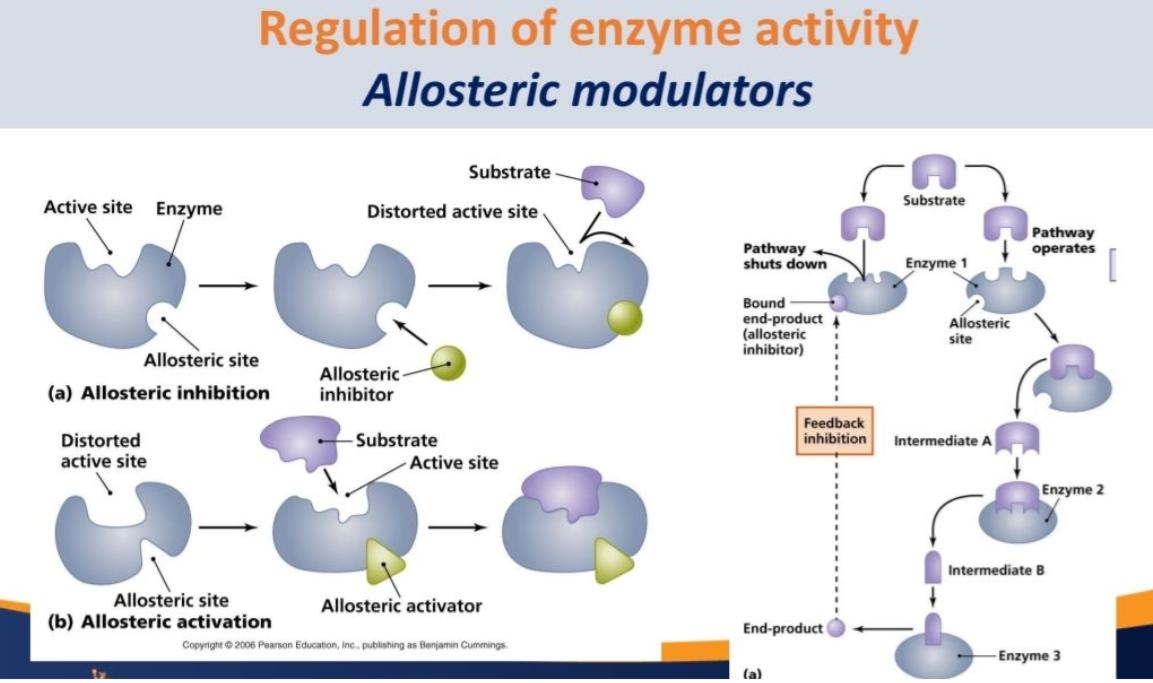
Factors that influence enzyme activity
-
Temperature & pH
-
Substrate concentration
-
competitive inhibitors another molecule mimics the substrate & binds to active site which blocks the active site and prevents substrate from binding
-
-
cofactor inorganic metal ions conformational changes of active site
-
coenzymes small organic molecules (vitamins, NAD+, FAD+) act as receptor or carries for atoms or functional group that are removed from substrate
