L2 Basic Genetics
🧠 Concepts Introduced
LIST
FROM "00 Archive/Objects/Concepts"
WHERE lecture = this.file.link
genetics: DNA RNA protein, any substances that have nucleic acid
Summary and Key Takeaways
- Mendel's laws remain the foundation of classical genetics
- Variations exist but principles still guide inheritance studies
Historical Background
-
Introduce Gregor Mendel as the father of genetics and his landmark work on pea plants.
-
Gregor Mendel (1822-1884)
-
Experiments with Pisum sativum (pea plants)
-
Published in 1866
Why Pea Plants
-
Easy to cultivate
-
Distinct traits
-
Controlled pollination
-
Short generation time
Key Genetic Terminology
Gene, Allele, Dominant, Recessive, Homozygous, Heterozygous, Genotype, Phenotype
Clarify essential vocabulary with examples (e.g., Tall (T) vs Dwarf (t)).
Mendel's Experimental Design
-
Cross-pollination of pure lines
-
Observation of F1 and F2 generations
-
Statistical analysis
Law of Segregation (1st Law)
Each organism carries two alleles for a trait, which segregate during gamete formation."
Use a simple example (Tt→ T + t gametes) to illustrate allele separation in meiosis.
Punnett Square: Monohybrid Cross
Example: Tall (TT) x Dwarf (tt) → F1 (Tt), F2 ratio 3:1
Demonstrate with a Punnett square how segregation leads to phenotypic ratios

Genotypic and Phenotypic Ratios
F2 generation: Genotype: 1 TT: 2 Tt: 1 tt
Phenotype: 3 Tall: 1 Dwarf
Differentiate between genotype and phenotype outcomes.
Monohybrid Cross Summary
One trait studied
Law of Segregation validated
3:1 phenotypic ratio
Law of Independent Assortment (2nd Law)
Alleles of different genes assort independently during gamete formation
Dihybrid Cross: Example
Seed shape (R/r) and color (Y/y) RrYy x RrYy → 9:3:3:1 ratio
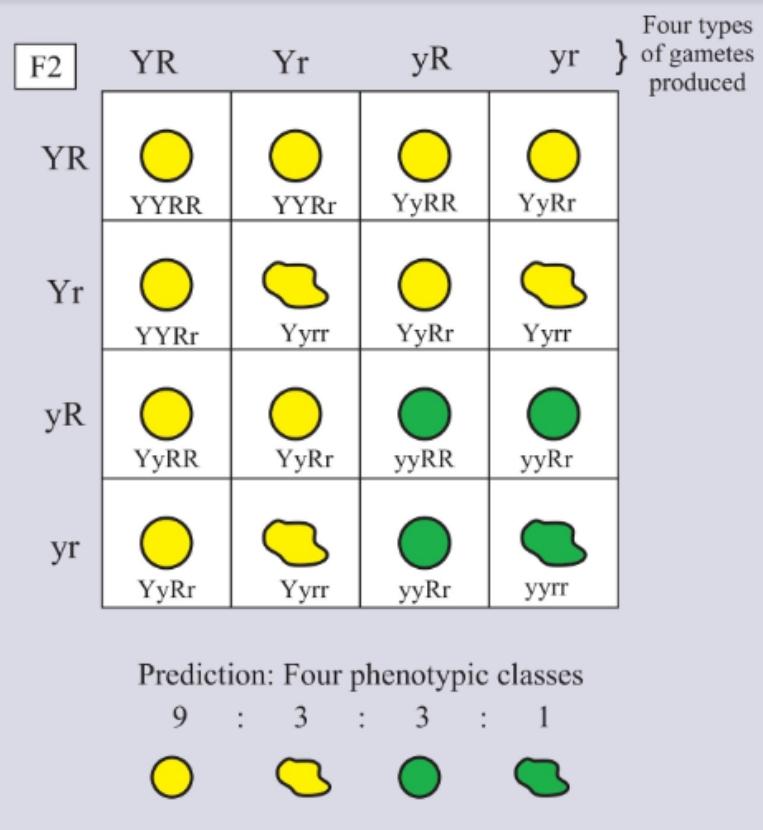
Dihybrid Cross Punnett Square
Gametes: RY, Ry, rY, ry
F2: 9 round yellow, 3 round green, 3 wrinkled yellow, 1 wrinkled green
Visualization of Independent Assortment
Diagram showing meiosis I and II separating alleles on different chromosomes
Applications of Mendel's Laws
-
Prediction of inheritance patterns
-
Genetic counseling
-
Plant and animal breeding
-
Understanding hereditary diseases
Extensions to Mendel's Principles
Incomplete dominance
Red (RR) x White (rr) → Pink (Rr)
Show deviation from Mendelian 3:1 ratio (now 1:2:1)

Codominance
Blood group AB (IAIB)
Codominance is a pattern of inheritance occurring at a single gene locus where both alleles are fully and simultaneously expressed in a heterozygote's phenotype. Neither allele is dominant over the other, and neither masks the other. Key Characteristic: Heterozygotes display both distinct traits concurrently rather than an intermediate blend.
Distinction: Unlike incomplete dominance (where red and white flowers yield pink offspring), codominance causes both parental phenotypes to appear side-by-side.
Example: ABO Blood Type (I^A I^B): An individual inheriting the I^A allele from one parent and I^B from the other produces both A-type and B-type carbohydrate antigens on the surface of their red blood cells, resulting in blood type AB. Roan Coat Color: In cattle and horses, crossing a red-furred parent (R^R R^R) and a white-furred parent (R^W R^W) produces a roan offspring (R^R R^W) with distinct, intermixed red and white hairs.
Multiple alleles
Key Characteristic: Even though a population has a pool of three or more alleles for a given gene, an individual diploid organism can only inherit two of those alleles (one from each parent).
Distinction: Expands the number of possible genotypes and phenotypes beyond traditional two-allele Mendelian genetics.
Example:
Human ABO Blood Group: The single gene controlling ABO blood type has three common alleles: I^A, I^B, and i.
I^A and I^B are codominant to each other.
Both I^A and I^B are completely dominant over the recessive i allele.
Rabbit Coat Color: A single gene locus (C) has four alleles in a dominance hierarchy (C > c^{ch} > c^h > c), producing full color, chinchilla, Himalayan, or albino phenotypes.
Epistasis
Epistasis is a form of gene interaction where the expression of one gene locus masks, modifies, or depends on the alleles present at a completely different gene locus.
Key Characteristic: Involves an interaction between two or more distinct genes operating in a shared biological or biochemical pathway. The gene doing the masking is epistatic; the gene being masked is hypostatic.
Distinction: Codominance and multiple alleles describe interactions between alleles at a single gene locus. Epistasis describes interactions across multiple separate gene loci.
Example:
Labrador Retriever Coat Color: Determined by two separate gene loci (B and E):
Gene B (Pigment Color): Dominant B yields black pigment; recessive b yields brown (chocolate) pigment.
Gene E (Pigment Deposition): Dominant E allows pigment to deposit into the hair shaft; recessive e blocks pigment deposition.
If a dog inherits ee at the second locus, no pigment is deposited regardless of the B locus alleles (B_ee or bbee). This results in a yellow Labrador. The E locus is epistatic to the B locus.
Human Genetics and Mendelism
Cystic fibrosis (autosomal recessive)
Huntington's disease (autosomal dominant)
Blood groups (codominance)
Pedigree Analysis
Symbols and rules for interpreting family trees
Autosomal Dominant Inheritance
Example: Huntington's disease One copy of allele sufficient to cause disease
Autosomal Recessive Inheritance
Example: Cystic fibrosis Both alleles must be defective
Show carrier parents (heterozygous) leading to affected offspring (25%).
Sex-linked Inheritance
Example: Hemophilia, Color blindness
Explain how X-linked traits follow non-Mendelian ratios due to hemizygosity in males.
Limitation of Mendel's Laws
-
Linkage • Definition: Genes located close together on the same chromosome tend to be inherited together as a unit. • Violation of Mendel: This breaks the Law of Independent Assortment, which assumes genes sort separately into gametes. • Example: Fruit fly studies show that body color and wing size genes on the same chromosome often pass down as a pair unless crossing over (genetic recombination) separates them
-
Polygenic inheritance • Definition: A single trait is controlled by multiple genes working together with additive effects. • Violation of Mendel: Instead of producing distinct categorical ratios (like 3:1), polygenic traits produce a smooth, continuous spectrum of phenotypes (often forming a bell curve). • Example: Human height is influenced by over 400 different genes, and skin color or eye color involve multiple interacting loci
-
Environmental effects • Definition: External non-genetic factors—such as diet, temperature, or lifestyle—can alter how a genotype is expressed. • Violation of Mendel: Mendel’s rules assume a fixed genotype always leads to a predictable phenotype. The environment can modify, mask, or mimic genetic traits. • Examples: • Human Height: A person may have the genetic potential to be tall, but poor childhood nutrition or chronic illness can limit actual growth. • Phenylketonuria (PKU): A genetic disorder where the body cannot process phenylalanine; however, severe symptoms can be prevented by following a strict low-phenylalanine diet. • Temperature-sensitive traits: Certain animals or mutants (such as vestigial wings in fruit flies) only display specific physical traits under particular temperature conditions.
Chromosomal Basis of Inheritance
Sutton-Boveri theory linking Mendel's factors to chromosomes:
The Sutton-Boveri Chromosome Theory (also called the chromosome theory of inheritance) states that genes are located at specific positions on chromosomes and that the behavior of chromosomes during meiosis explains Gregor Mendel’s laws of inheritance. Technically, Meiosis phase 1 + Telophase phase 2
Mendelian Ratios Summary Table

Clinical Relevance
-
Predicting genetic disorders
-
Prenatal genetic counseling
-
Carrier screening
