L4 Cell Biology
🧠 Concepts Introduced
LIST
FROM "00 Archive/Objects/Concepts"
WHERE lecture = this.file.link
Learning Objectives: Understand the principle of cellular respiration Explain how glucose molecule contribute to the production of ATP Explain the difference between anaerobic and aerobic cellular respiration Understand how does regulation mechanism work in cellular respiration
Summary: Introducing various chemical reactions and activated carrier molecules involved in cellular metabolism
Aerobic cellular respiration - From glycolysis to ETC
Other metabolic processes such as anaerobic cellular respiration, gluconeogenesis, glycogenesis
Thermodynammics
Study of the change in energy that accompany events in the universe There are TWO LAWS of thermodynamics:
- Energy can NEITHER be created nor destroyed, but can be converted from one form to another
- In the path of energy transformation, some energy loss in the form of heat, and the entropy increases.
The flow of energy
Organisms release energy from their carbon compounds by cell respiration and then use it for cell activities. Energy released in this way is eventually lost to the environment as waste heat.
Sunlight energy is converted to chemical energy in carbon compounds by photosynthesis (CO2+ H2O sugars, O2 and heat) Chemical energy in carbon compounds flows through food chains by means of feeding Energy released by respiration is used in living organisms and converted to heat. Heat is lost from ecosystems
Why cells need energy
Why a cell needs energy? To fuel cellular processes
What are the processes?
- Active transport
- Cell signaling
- For energy storage (glycogen/fat/starch)
- Synthesize macromolecules for structural and functional maintenance
Intro to cellular metabolism
Catabolism vs Anabolism
Coupled Chemical Reactions
Activated Carrier Molecules
Hydrolysis vs Condensation
Catabolism
Catabolic pathways involve the breakdown of nutrient molecules into usable forms (building blocks).
Energy released during the process is either stored in energy molecules for later use or released as heat.
- Disassemble complex molecules to form simpler products.
- Generate raw materials from which other molecules can be synthesized
- Provide chemical energy for other cellular activities (exergonic).
Aerobic Respiration
-
Relies on adequate supply of O, to cells
-
Cells use O2 to release energy from glucose
Anaerobic Respiration
- Demand for O, exceeds the body's ability to deliver
- Glucose is broken down to produce lactic acid
Anabolism
Anabolic pathways then build
new molecules out of the products of catabolism, and these pathways typically use energy.
The new molecules (macromolecules) built via anabolic pathways are useful for building cell structures and maintaining the cell
- Synthesis of more complex compounds from simpler starting materials.
- Energy-requiring (endergonic)
- Utilize chemical energy released by exergonic catabolic pathways.

Coupled Chemical Reactions
Direct burning of sugar is too large to be captured by any carrier molecules, and all energy is released as heat.
In a cell, the breakdown of sugars via a series of enzymatic steps, in which a portion of the free energy released is captured by the formation of carrier molecules, eg. ATP and NADH

because the energy released is huge and need molecule to capture these huge amounts of energy. If energy is released directly into heat and not stored in cells.
each step catures energy by energy carrier
Activated Carrier Molecules in Cells
Adenosine Triphosphate (ATP)
ATP consists of a nitrogenous base (adenine), a ribose sugar, and three bonded phosphate groups.
The energy is stored in the bond between the second and third phosphate groups.
When the cell requires energy, the third phosphate group becomes detached from ATP, releasing energy in that bond for the cell to use.
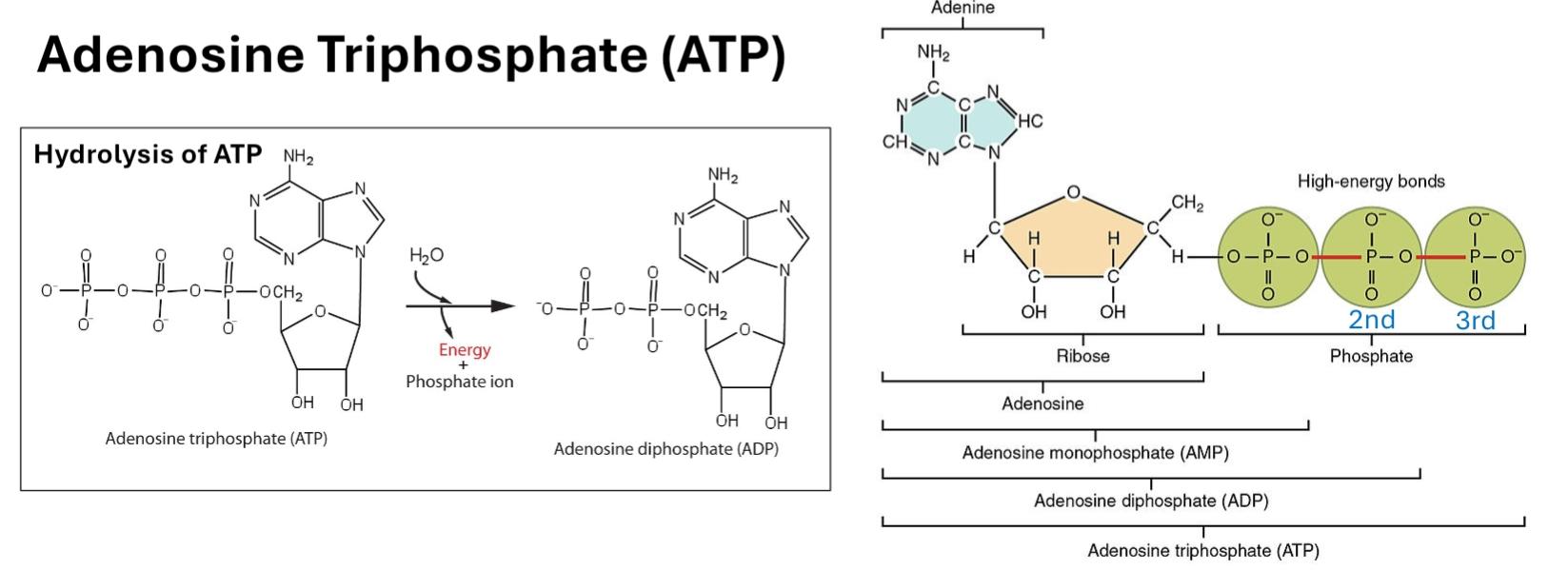
Energy release from the phosphate bond
Energy (in a form of phosphate group) from food is transferred to ADP (1 P)
Energy from food is then stored as a phosphate bond in ATP. (1P + 2P)
Energy is released when the phosphate bond is broken and can be used to fuel the cellular activities
Nicotinamide Adenine Dinucleotide + Hydrogen (NADH)
Nicotinamide Adenine Dinucleotide (NAD+) have two nucleotides, adenine and nicotinamide.
NAD+ (in the oxidized form) accepts electrons from food to become NADH (the reduced form)
NADH is a high-energy molecule and it readily transfers its electrons to the chain of enzymes in mitochondria that are involved in producing ATP (electron transport chain).
As electrons move through a series of redox reactions, energy is released. NADH is converted back to NAD+.
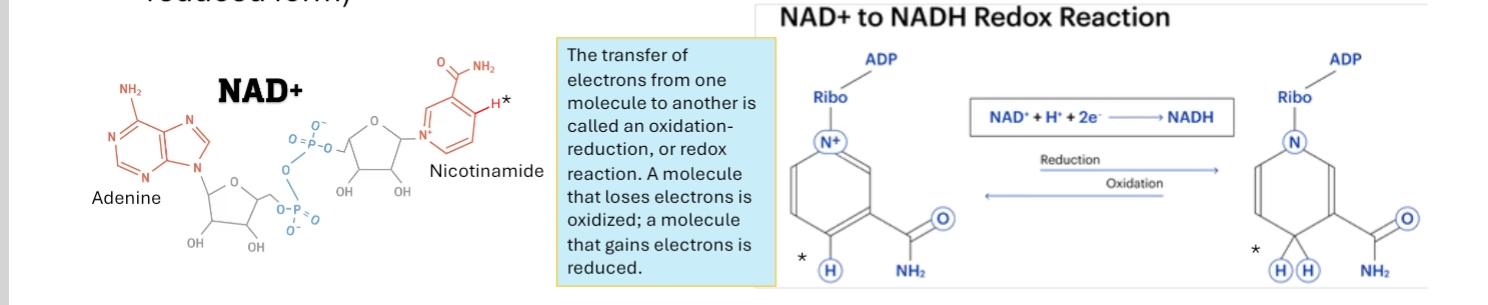
Activated carrier molecules

Pyruvate Oxidation (An example of carrier molecules in metabolism) Pyruvate (a 3-carbon molecule) is converted to acetyl CoA, a two-carbon molecule attached to coenzyme A. This reaction releases a molecule of carbon dioxide and reduces a NAD+ to NADH.
-
A carboxyl group is removed from pyruvate and released as carbon dioxide.
-
The resulting two carbon molecule is oxidized, and NAD+ acts as the electron acceptor for the lost electrons, forming NADH.
-
The oxidized two-carbon molecule is attached to Coenzyme A to form acetyl CoA. Acetyl CoA carries the acetyl group to the Kreb's cycle.
Hydrolysis vs Condensation

When water is added to a molecule to break it apart into two molecules this reaction is called hydrolysis.
Condensation (dehydration synthesis) involves the removal of water from two molecules to join them together into a larger molecule
Cellular Respiration
What is cellular respiration
A process to harvest the energy in the form of ATP from chemical-bond energy locked in sugars.
During cellular respiration, energy is extracted from organic molecules, such as glucose, through a series of chemical reactions. This energy is then used to produce ATP, which is the primary energy currency of the cell
- Glycolysis
- Formation of acetyl CoA
- Citric acid cycle
- Electron transport and Chemiosmosis
only glycolysis happen in cytoplasm the rest all in mitonchondrial
1. Glycolysis
!!! glycolysis happen in both anaerobic and aerobic cuz it does not involve oxygen

i. Glycolysis is the first stage that occurs in both aerobic and anaerobic respiration, and the reactions take place in the cytoplasm of the cell.
ii. Glycolysis contains 2 phases (preparatory phase and payoff phase).
iii. It is an anaerobic stage of respiration, creating ATP without the use of oxygen.
iv. ATP is formed by addition of P₁ to ADP, and the remainder of energy during glycolysis is stored in the electrons in the NADH molecule

i. Glycolysis contains 2 phases with 10 steps, each producing a different sugar intermediate and each catalyzed by a different enzyme.
ii. In glycolysis, 2 ATP molecules are consumed, producing 4 ATP (net ATP is 2), 2 NADH, and 2 pyruvates (C3) per glucose molecule (C6) per glucose
iii. The pyruvate can be used in the citric acid cycle or serve as a precursor for other reactions
net gain of ATP is 2 one glycolysis use 2 ATP produce 4 ATP and 2 NADH and 2 pyruvate
Preparatory phase (Glycolysis)
step 1 - 3

-
In steps 1-3, the 6-carbon glucose molecule is phosphorylated.
-
This means that phosphate groups are added to glucose by the coenzyme ATP.
-
Second phosphorylation, 2 molecules of ATP are used at the end.
The product is fructose 1,6- bisphosphate, a phosphorylated sugar.
first phospholation: this is only change glucose to fructose (change in structure) second phospholation: adding phosphate to carbon no.1
-
Phosphorylation at carbon 6 • Reactant: Glucose (a 6-carbon sugar ring). • Enzyme: Hexokinase • Action: Hexokinase transfers a phosphate group from a molecule of ATP to the hydroxyl group on carbon-6 ((C_{6})) of the glucose molecule. This converts ATP to ADP. • Product: Glucose 6-phosphate (G6P) • Significance: • This reaction is irreversible under intracellular conditions. • Adding a negatively charged phosphate group traps the glucose inside the cell, as it can no longer cross the plasma membrane via passive glucose transporters. • It keeps intracellular free glucose concentrations low, encouraging more glucose to enter the cell.
-
Isomerization (Step 2)
• Reactant: Glucose 6-phosphate • Enzyme: Phosphohexose isomerase (also known as phosphoglucose isomerase). • Action: This enzyme catalyzes the reversible rearrangement (isomerization) of an aldose (glucose 6-phosphate) into a ketose (fructose 6-phosphate). The six-membered pyranose ring of glucose is converted into a five-membered furanose ring of fructose. • Product: Fructose 6-phosphate (F6P) • Significance: • This reaction is freely reversible. • It relocates the carbonyl oxygen from carbon-1 to carbon-2, which exposes carbon-1 ((C_{1})) so it can be phosphorylated in the next step.
- The Second Priming Reaction (Step 3)
• Reactant: Fructose 6-phosphate • Enzyme: Phosphofructokinase-1 (PFK-1) • Action: PFK-1 transfers a second phosphate group from another molecule of ATP to the newly exposed hydroxyl group on carbon-1 ((C_{1})) of fructose 6-phosphate. • Product: Fructose 1,6-bisphosphate (F1,6BP) • Significance: • This is a highly irreversible, regulated, and committed step in glycolysis. Once glucose is converted to F1,6BP, it must proceed through the rest of the glycolytic pathway. • PFK-1 is a key allosteric regulatory enzyme that acts as a cellular "valve," speeding up or slowing down glycolysis based on the cell's energy needs (inhibited by high ATP, activated by high AMP/ADP).
step 4 - 5

They are glyceraldehyde 3-phosphate (or G3P) and dihydroxyacetone phosphate (or triose phosphate)
- Dihydroxyacetone phosphate is converted to glyceraldehyde 3-phosphate, gaining two glyceraldehyde 3-phosphate.
step 4. The Cleavage Reaction
• Enzyme: Aldolase • Substrate: Fructose 1,6-bisphosphate (a symmetrical 6-carbon ring with two phosphate groups). • Action: The enzyme catalyzes a reversible aldol cleavage, splitting the open-chain form of Fructose 1,6-bisphosphate between the C-3 and C-4 carbons. • Products: This split generates two distinct 3-carbon isomers: • Glyceraldehyde 3-phosphate (G3P): An aldose sugar that can directly continue down the glycolytic pathway. • Dihydroxyacetone phosphate (DHAP): A ketose sugar that cannot be directly utilized in the subsequent steps of glycolysis.
Step 5: The Isomerization Reaction
• Enzyme: Triose phosphate isomerase (TIM) • Substrate: Dihydroxyacetone phosphate (DHAP). • Action: Since only G3P can proceed into the energy payoff phase, this enzyme rapidly and reversibly converts DHAP into its structural isomer, G3P. • Equilibrium: Under standard conditions, the equilibrium favors DHAP. However, because G3P is constantly consumed in the very next step of glycolysis, the reaction is continuously driven forward according to Le Chatelier's principle.
Through the combined action of these two steps, one molecule of Fructose 1,6-bisphosphate yields two molecules of Glyceraldehyde 3-phosphate (G3P). This effectively doubles the output of the remaining steps of glycolysis, meaning all subsequent energy yields (ATP and NADH production) are multiplied by two per original glucose molecule.
split the frustose 1,6 - biphosphate to 2 molecule total have 2 G3P
Payoff phase (Glycolysis)

step 6 - 10 The two molecules of G3P undergo a series of reactions to be converted into the final products of glycolysis, two molecules of the three-carbon pyruvate.
-
2x G3P molecules each has a hydrogen removed by co-enzyme NAD+ and a phosphate group attached.
-
This newly added phosphate group is transferred from each 1,3- bisphosphoglycerate to two molecules of ADP, forming 2x ATP.
-
In each 3-phosphoglycerate, phosphate group is reattached to second carbon and water is removed. (regrouping only)
-
Enolase removes water, creating a high- energy intermediate.
-
Phosphate group is removed from each phosphoenolpyruvate, generating ATP.
Step 6: Oxidation & Phosphorylation
• Reactant: (2) Glyceraldehyde 3-phosphate (GAP) • Enzyme: Glyceraldehyde 3-phosphate dehydrogenase • What Happens: The aldehyde group of GAP is oxidized while an inorganic phosphate is attached. This reaction reduces NAD+ into NADH. • Product: (2) 1,3-Bisphosphoglycerate (1,3-BPG) • Energy Yield: 2 NADH + 2 H+ • Key Concept: This is the only step in glycolysis that generates reducing power NADH which is later used in the electron transport chain to make more ATP.
Step 7: The First ATP Generation
• Reactant: (2) 1,3-Bisphosphoglycerate • Enzyme: Phosphoglycerate kinase • What Happens: 1,3-BPG is a very high-energy molecule. The enzyme transfers a high-energy phosphate group from the C-1 position of each 1,3-BPG directly to ADP, creating ATP. • Product: (2) 3-Phosphoglycerate • Energy Yield: 2 ATP • Key Concept: This process is called substrate-level phosphorylation because the phosphate group is transferred directly from a substrate molecule to ADP without needing oxygen.
Step 8: The Phosphoryl Shift
• Reactant: (2) 3-Phosphoglycerate • Enzyme: Phosphoglycerate mutase • What Happens: The remaining phosphate group is shifted from the 3rd carbon (C-3) to the 2nd carbon (C-2). • Product: (2) 2-Phosphoglycerate • Key Concept: This isomerisation rearranges the molecule to set it up for the high-energy release in the next steps.
Step 9: Dehydration
• Reactant: (2) 2-Phosphoglycerate • Enzyme: Enolase • What Happens: A water molecule H2O is removed from each 2-phosphoglycerate molecule. • Product: (2) Phosphoenolpyruvate (PEP) • Byproducts: 2 H2O • Key Concept: The elimination of water introduces a double bond, converting the low-energy phosphate ester into an extremely unstable and high-energy enol phosphate bond.
Step 10: The Second ATP Generation
• Reactant: (2) Phosphoenolpyruvate (PEP) • Enzyme: Pyruvate kinase • What Happens: Because PEP is highly unstable, it readily transfers its phosphate group to ADP, forming ATP. The molecule then spontaneously tautomerizes into its stable keto form. • Product: (2) Pyruvate (The end product of glycolysis) • Energy Yield: 2 ATP • Key Concept: This is the second instance of substrate-level phosphorylation. This step is highly exergonic (releases a lot of energy) and is completely irreversible under cellular conditions
net gain for one full molecule of glucose entering glycolysis is: • 2 Net ATP • 2 NADH • 2 Pyruvate
2. Formation of Acetyl CoA (Pyruvate Oxidation)

Pyruvate must enter the mitochondrion, passing through its inner membrane and to the matrix.
A carboxyl group is removed from pyruvate and released as carbon dioxide.
The resulting two carbon molecules are oxidized, and NAD+ acts as the electron acceptor for the lost electrons, forming NADH.
The oxidized two-carbon molecule is attached to Coenzyme A to form acetyl CoA. Acetyl CoA carries the acetyl group to the Kreb's cycle
For each glucose molecule, 2 molecules of pyruvate are converted into 2 molecules of acetyl-CoA during pyruvate oxidation, releasing 2 carbons as carbon dioxide and generating 2 NADH from NAD+.
respiration breathe out carbon dioxide is produced here
When CO2 leaves, a hydrogen atom from the enzyme environment is temporarily added to the central carbon. This creates a stable, 2-carbon intermediate bound to TPP called a hydroxyethyl group: CH3 - CH (OH) bound to TPP Notice that the central carbon now has an alcohol group OH and a single hydrogen atom H attached to it.
• NAD+ takes 2e- and 1H+ to become NADH. • The remaining 1H+ is released into the mitochondrial matrix as a free hydrogen ion
Mitochondrial Entry via Transport Proteins
• The Location Shift: Glycolysis takes place in the cytosol. However, the Krebs cycle occurs inside the mitochondrial matrix. • The Mechanism: Pyruvate is a charged molecule (polar), so it cannot freely diffuse across the lipid bilayer. It passes through the outer mitochondrial membrane via large pores and is then actively moved across the inner mitochondrial membrane into the matrix by a specific transport protein (pyruvate translocase).
- Decarboxylation
• The Reaction: Once inside the matrix, a carboxyl group COO- is stripped away from the 3-carbon pyruvate molecule. • The Output: This carboxyl group is released into the cell as a molecule of carbon dioxide CO2, which eventually diffuses out of the cell and is exhaled. This reduces the 3-carbon pyruvate down to a 2-carbon acetyl fragment.
- Oxidation and NADH Generation
• The Reaction: The remaining 2-carbon fragment undergoes oxidation (loss of electrons). • The Output: The electrons and hydrogen ions H+ stripped during this oxidation are transferred to the electron carries NAD+. This reduces NAD+ into NADH + H+. The generated NADH will later travel to the electron transport chain to help produce ATP.
- Coenzyme A Attachment
• The Reaction: The unstable, oxidized 2-carbon acetyl group is immediately attached to a sulfur atom on a helper molecule called Coenzyme A (CoA-SH). • The Output: This binding forms Acetyl CoA. The bond between the acetyl group and Coenzyme A is highly unstable and high-energy, perfectly preparing the 2-carbon acetyl chunk to be cleanly delivered to and accepted by the Krebs cycle.
3. KREB Cycle (Citric Acid Cycle or TCA tricarboxylic acid)

The acetyl CoA combines with a 4- carbon compound called oxaloacetate and forms a 6-carbon molecule called citrate.
Along the way, two molecules of CO2 are released, and oxaloacetate gets reused.
The net result per Acetyl-CoA that is released: (energy carrier) 3 NADH 1 FADH2 1 ATP 2 CO2
- Cycle Entry & Initialization
-
Acetyl-CoA Join: Acetyl-CoA (2C) combines with oxaloacetate (4C).
-
Citrate Formation: This fusion creates citrate (6C), initiating the loop.
-
Isomerization: Citrate undergoes a structural shift to become iso-citrate.
- Carbon Release & Energy Harvesting
-
First Decarboxylation: Iso-citrate turns into alpha-ketoglutarate, releasing the first CO2 molecule and producing NADH.
-
Second Decarboxylation: alpha-ketoglutarate turns into succinate, releasing the second CO2, producing a second NADH, and generating ATP directly.
- Regeneration of Oxaloacetate
-
FADH₂ Production: Succinate is converted into fumarate, which reduces FAD to FADH2.
-
Final NADH Generation: Fumarate is oxidized back into oxaloacetate, producing a third NADH molecule.
-
Cycle Reset: The regenerated oxaloacetate is now ready to bind with a new Acetyl-CoA molecule.
4. Electron Transport Chain (ETC) & Chemiosmosis
inside inner membrane is the mitochondrial matrix (KREB Cycle and ETC)
at least 32 ATP
ETC, the final stage in energy generation, most ATPs are released here.
It occurs in the inner membrane of mitochondria
Electron carriers, NADH and FADH2, transfer electrons to ETC.
As electrons passed along the chain of specialized electron acceptor or donor molecules, they fall to lower energy states
ETC

-
NADH → Complex I (NADH dehydrogenase) NADH transfers 2 electrons to Complex I. Complex I uses the energy from these electrons to pump protons (H*) from the mitochondrial matrix to the intermembrane space (between outer & inner)
-
FADH, → Complex II (succinate dehydrogenase) FADH, donates its electrons here (a bit later in the chain). Complex II does not pump protons, but it passes electrons to the next carrier.
complex 2 don't pump proton
-
Ubiquinone (Coenzyme Q) A small, mobile electron carrier that moves electrons from Complex I and II to Complex III. pump proton from matrix to intermembrane space.
-
Complex III → Cytochrome c Complex III also pumps protons and passes electrons to cytochrome c, another small mobile carrier.
-
Complex IV (cytochrome c oxidase) Electrons are passed to oxygen (O2), the final electron acceptor. 1/2 oxygen combines with 2 electrons and 2 protons to form a stable water (H₂O
that's why oxygen is important
The Core Goal of the Electron Transport Chain (ETC)
The primary purpose of the ETC is to convert the energy stored in high-energy electron carriers (NADH and FADH2) into a proton gradient across the inner mitochondrial membrane. This gradient acts like water stored behind a dam, creating proton-motive force that ultimately drives the synthesis of ATP (cellular energy).
Detailed Step-by-Step Breakdown of the Chain
1. Complex I (NADH Dehydrogenase)
- Electron Entry: NADH drops off two high-energy electrons here, oxidizing into NAD+.
- Proton Pumping: As these electrons move through Complex I, their energy triggers a conformational change that pumps 4 protons H+ from the matrix into the intermembrane space
2. Complex II (Succinate Dehydrogenase)
- Electron Entry: FADH2 donates its two electrons here, oxidizing into FAD+
- Proton Pumping: Complex II does not pump any protons. The energy level of electrons from FADH2 is lower than those from NADH, which is why FADH2 results in less ATP production overall.
3. Ubiquinone (Coenzyme Q)
- The Shuttle: This is a small, fat-soluble mobile electron carrier residing inside the lipid bilayer (labeled as 3 in your diagram).
- Function: It collects the pairs of electrons delivered to both Complex I and Complex II and carries them horizontally through the membrane to Complex III.
- Clarification on your note: Ubiquinone itself does not pump protons directly across the membrane, but it plays a crucial role in delivering electrons (and picking up protons dynamically during the "Q cycle") to power the pumping mechanism at Complex III.
4. Complex III (Cytochrome (c) Reductase)
- Electron Transfer: Receives electrons from Ubiquinone and passes them to Cytochrome (c).
- Proton Pumping: The energy released from this transfer allows Complex III to pump 4 more protons H+ out into the intermembrane space.
5. Cytochrome (c)
- The Shuttle: A small, water-soluble peripheral protein located on the intermembrane space side of the membrane.
- Function: It carries one electron at a time from Complex III to Complex IV.
6. Complex IV (Cytochrome (c) Oxidase)
- Final Transfer: Receives electrons from Cytochrome (c) and passes them directly to oxygen.
- Proton Pumping: The final drop in electron energy allows Complex IV to pump 2 protons H+ into the intermembrane space.
The Final Step: Why Oxygen O2 is Vital
Oxygen serves as the final electron acceptor at the very end of the transport chain.
1/2 O2 + 2e- + 2H+ -> H2O
- Clearing the Traffic Jam: Oxygen acts like a vacuum at the end of a slide. By continually taking away the spent, low-energy electrons, it keeps the entire chain moving forward.
- Water Formation: When oxygen accepts 2 electrons, it becomes highly reactive and immediately bonds with 2 free hydrogen ions H+ in the matrix to form harmless water H2O.
What happens if oxygen is missing?
If there is no oxygen, Complex IV cannot dump its electrons. The electrons back up like a traffic jam, halting Complexes III, II, and I. Protons stop pumping, the proton gradient collapses, and ATP production ceases entirely—which is why suffocation or cellular poisons like cyanide (which blocks Complex IV) are rapidly fatal.
Chemiosmosis
Hydrogen ions (high concentration) can only pass through the inner mitochondrial membrane through an integral membrane protein called ATP synthase.
H+ move down to their electrochemical gradient (facilitated diffusion - Chapter 3).
ATP synthase facilitates the addition of a phosphate (Pi) to ADP, forming ATP, using the potential energy of the hydrogen ion gradient.
Summary: Chemiosmosis is a biological process wherein ions (usually protons, H+) are moved to the other side of the membrane resulting in the generation of an electrochemical gradient that can be used to drive ATP synthesis.
. The Setup: Generating the Proton-Motive Force
Before ATP synthesis can happen, the Electron Transport Chain (ETC) actively pumps hydrogen ions across the inner mitochondrial membrane into the intermembrane space. This builds up a high concentration of protons outside the matrix, creating an electrochemical gradient (a combination of a chemical concentration difference and an electrical charge difference). This gradient represents a large amount of stored potential energy, known as the proton-motive force.
- Facilitated Diffusion through the Rotor
Because the phospholipid bilayer is impermeable to charged ions, the protons can only cross back down their concentration gradient into the mitochondrial matrix through a specialized channel inside the integral membrane protein called ATP synthase. As protons flow through this channel subunit embedded in the membrane), they cause the base of the protein to physically rotate like a miniature water wheel or turbine.
- Rotational Catalysis
The rotating base is attached to a central axle/shaft that extends into the stationary catalytic headpiece located in the mitochondrial matrix. As the central shaft turns, it physically deforms and changes the 3D shape (conformation) of the surrounding active sites on the subunit.
- Phosphorylation of ADP to ATP
The active sites undergo three distinct conformational shifts during a full rotation:
-
Open (O) State: ADP and an inorganic phosphate loosely enter the active site from the matrix.
-
Loose (L) State: The site closes slightly, holding the ADP and phosphate in close proximity.
-
Tight (T) State: The rotation of the internal shaft forces the active site into a tight compression. This mechanical squeezing provides the necessary activation energy to force the negatively charged ADP and phosphate group together, forming a new high-energy covalent bond.
Once the bond is formed, the site returns to the Open state, releasing the newly synthesized ATP molecule into the matrix so the cycle can repeat.

Total energy production

About 34% of the energy in a glucose molecule is transferred to ATP during cellular respiration, making about 36-38 ATPs
ETC and chemiosmosis produce 32 ATP from 1 glucose molecule
Anaerobic Cellular Respiration

Pyruvate is the end product of glycolysis, stands at the junction between anaerobic and aerobic pathways.
Two pathways for the anaerobic breakdown of pyruvate - fermentation leading to excretion of (1) alcohol and CO2 and (2) lactate
In anaerobic energy-yielding pathways, pyruvate and NADH molecules stay in cytosol.
Alcohol Fermentation

In alcohol fermentation, pyruvate is converted to ethanol in two steps, with the first step releasing CO2
NADH release its electrons and is converted back to NAD+, which is required recycled back in glycolysis.
Alcohol fermentation by yeast is used in brewing, winemaking, and baking
Lactate Fermentation

In lactate (or lactic acid) fermentation, pyruvate is reduced by NADH, forming lactate as the end product, with no release of CO2
Lactic acid fermentation by some fungi and bacteria is used to make cheese and yogurt
Human muscle cells use lactic acid fermentation to generate ATP when O2 is scarce

Fats & proteins metabolism

In addition to sugar, fat and proteins can be broken down to generate energy
Triglyceride+3H2O → Glycerol+3 Fatty acids
-
Glycerol can be converted into glyceraldehyde-3-phosphate (G3P), an intermediate in glycolysis
-
Similar to pyruvate from glycolysis, fatty acids derived from fat are converted into acetyl CoA in the mitochondrial matrix
Some amino acids can be converted to pyruvate, or transported to acetyl CoA or one of the intermediates of the Krebs Cycle
Regulation of Metabolism
In a cell, many sets of reactions need to be coordinated and controlled eg. animals only have periodic access to food while plants need to survive without sunlight overnight
One of the ways is the synthesize food reserves that can be later consumed
Hence, the organisms need to decide when to build molecules (anabolism) or burn them for energy (catabolism)
An elaborate network of control mechanisms regulates and coordinates the enzyme activity (mainly through addition or removal of a phosphate group OR by the binding of small regulatory molecules/ metabolite
Feedback Regulation

cuz too much ATP is not good
Feedback regulation is a control mechanism where the end product of a metabolic pathway influences the activity of enzymes earlier in the pathway - either slowing down or speeding up the process.
In glycolysis, the enzyme phosphofructokinase (PFK) controls a key step. When ATP levels are high, ATP binds to PFK and inhibits it.
Citrate can also serve as feedback inhibitor to PFK, down-regulating the glycolysis.
Gluconeogenesis

Gluconeogenesis supplies the needs for plasma glucose during intense physical exercise or fasting.
Gluconeogenesis is stimulated by hormones (glucagon, growth hormone, epinephrine, and cortisol) in the liver and kidneys.
Gluconeogenic substrates are non- carbohydrate precursors include glycerol, pyruvate, lactate, 18 amino acids, etc.
One of the way to increase available glucose is to synthesize it from pyruvate, a reverse of glycolysis.
dihydroxyacetone phosphate <- glycerol pyruvate <- lactate, alanine pyruvate & oxaloacetate <- other amino acids
Primary Precursors & Entry Points Non-carbohydrate substrates enter the gluconeogenic pathway at different stages:
Glycerol - Dihydroxyacetone phosphate (DHAP)
- Derived from the breakdown of triacylglycerols (fats) in adipose tissue.
Lactate - Pyruvate
- Produced by anaerobic glycolysis in exercising skeletal muscle and red blood cells; recycled via the Cori cycle.
Alanine - Pyruvate
- Transaminated directly into pyruvate via the glucose-alanine cycle during muscle protein catabolism.
Other Glucogenic Amino Acids - Pyruvate or Oxaloacetate
- Derived from tissue protein degradation; enter the pathway either through conversion to pyruvate or as intermediates of the citric acid cycle (TCA cycle) to form oxaloacetate.
Glycogenesis (Storage in Reservoirs for future use)

In cells, glucose can be stored as glycogen or small granules in the cytoplasm (in liver and muscle cells) - Glycogenesis
It happens when ATP is high, and glucose 6-phosphate is high
Glycogenesis begins with the conversion of glucose 6-phosphate into glucose-1- phosphate.
Conjugation with UTP (uridine triphosphate) which releases two phosphate groups to form UDP-Glucose
Glycosylation is the linkage of individual UDP- Glucoses, forming glycogen, by glycogen synthase This enzyme creates alpha -1,4-glycosidic bonds to link individual glucose molecules sequentially, extending the glycogen granule.
On the other hand, glycogen breakdown is carried out by adrenaline or glucagon
