L2 Human Physiology
🧠 Concepts Introduced
LIST
FROM "00 Archive/Objects/Concepts"
WHERE lecture = this.file.link
Plasma membrane
Recap Learning outcome #1:
-
Identify the structure and components of plasma membrane - Lipid Bilayer - CPCP
-
Describe the functions of plasma membrane and membrane proteins - PECS


Function of plasma membrane
-
Physical barrier
- separate intracellular fluid and extracellular fluid (ECF)
-
Exchange of materials with the environment
-
entry of ions and nutrients into cell
-
elimination of cellular waste and release of products
-
-
Communication between cell and environment
- surface proteins respond and recognize other molecules
-
Structural support
- cell shape maintained by cytoskeletal proteins attached to membrane proteins
Phospholipid molecule
-
Polar head
- hydrophilic
- negatively charged phosphate group
-
2 nonpolar fatty acid tails
- hydrophobic
Membrane proteins
- structural proteins
- transporters
- channel proteins
- carrier proteins
- enzymes
- membrane receptor proteins
Membrane transport
Recap Learning outcome #2:
- Explain the different types of membrane transport - SOFAE
- Differentiate between passive transport, primary and secondary active transport - Energy & Co-transport
Simple Diffusion
- movement from down its concentration high concentration to low concentration
- does not require energy
- eg. gas exchange (O2, CO2) between cells and ECF in lungs
Osmosis
- water molecules down its concentration (from high concentration to low cincentration)
- travel from hyponic to hypertonic encironment

Facilitated Diffusion (depend on protein)
- similar to simple diffusion but require a carrier
- facilitate transfer from high to low concentration
- passive barrier - mediated transport
- ion channels & aquaporin (water) channels
- transport of glucose - glucose transporter (GLUT)
Active transport (ATP + depend on protein)
Primary active transport Na+ - K+ - ATPase pump:
- involves carrier protein
- utilizes ATP to drive transport of molecules against concentration gradient
-
Cytoplasmic Na+ binds to pump proteins
-
Na+ binding promotes hydrolysis of ATP, energy released during reaction phosphorylates the pump
-
Phosphorylation causes the pump to change shape, expel Na+ to the outside
-
Two extracellular K+ binds to pump
-
K+ binding triggers release of the phosphate, the dephosphorylated pump resumes its original confirmation
-
Pump protein binds ATP releases K+ to the inside, and Na+ site are ready to bind Na+ again. Cycle repeats
- utilizes potential energy stored in electrochemical gradients of ions to drive transport of another molecule (cotransport)
- gradients established and maintained by carrier proteins that utilizes ATP
Co-transport molecules across the plasma membrane - Same direction (symport) - glucose and amino acids - Opposite direction (antiport) - Na & H ions

Endocytosis & Exocytosis (vesicles)
-
Transport of large molecules across membrane
-
Formation of membrane-enclosed vesicles
-
Active method of membrane transport
-
Two types of vesicular transport: Endocytosis Exocytosis
Endocytosis Process by which substances move into cell
-
Phagocytosis - selective uptake of multimolecular particles (e.g., bacteria and cellular debris)
-
Pinocytosis - nonselective uptake of ECF fluid
-
Receptor-mediated endocytosis - selective uptake of large molecule (e.g., protein)
Exocytosis
-
Process by which substance is transported out of cell
-
Provides mechanism for secreting large polar molecules
-
Enables cell to add specific components to membrane
Cell to cell communication
Recap Learning outcome #3
- Describe the different types of cell-to-cell communication systems - SPED
- Identify the different groups of chemical messengers - PNH
Physiological signals: Electrical and chemical signals
Basic communications systems:
- Direct contact (gap junctions and contact-dependent signals)
- Paracrine and autocrine signaling
- Endocrine signaling
- Synaptic signaling
Direct Contact Communication
Direct contact communication of cells
- Gap junctions Heart, smooth muscle cells, neuron Protein channels - transfer between adjacent cells Membrane proteins: Connexins 6 Connexins forms a channel - Connexon Gap Junction: Connexons from 2 cells
- Contact - dependent signals will release signals to bound on the target
Chemical signaling between cellls
Paracrine: Autocrine signal - chemical signals act on cells that secreted it
Paracrine signal - chemicals act on cells in the immediate vicinity of cell secreting the signal
Some molecules may act as both an autocrine and paracrine signal
Signals reach target cell by diffusing through interstitial fluid - distance is the limiting factor for diffusion
Neurotransmitter: Nervous system - combination of chemical and electrical signals to communicate over long distance
Nerve cells can extend long processes called axons to very near the target cells
Electric signals travels along neuron until it reaches very end of cell, where it is translated into a chemical signal secreted by neuron
Neurotransmitter - chemical signals secreted by neurons diffuse across small gap to target cell and has a rapid effect
Neurohormone - chemicals released by neurons into the blood for action at distant targets
Hormones: Endocrine signals - cells of endocrine glands secrete hormone into ECF. hormones enter blood and carried by blood in cells in body, target cells respond to hormone
Signaling tranduction pathway
Recap Learning outcome #4
- Identify the receptors for lipophilic and lipophobic chemical messengers -Cytosol/Nuclear Vs Plasma Membrane
- Name the three categories of membrane receptors - ECG
Receptor protein
Lipophilic (hydrophobic) signal molecules
- bind to cytosolic receptors or nuclear receptors
Lipophobic (hydrophilic) signal molecules
- stay in the ECF and bind receptor proteins.

Membrane - bound receptors
Extracellular signals activates membrane receptor → alters intracellular molecules to create cellular response
Three major types:
- Channel-linked receptor
- Enzyme-linked receptors
- G-proteins - linked receptors
Channel - linked receptors
-
Acetylcholine, for example, binds to a ligand- gated channel in muscle cells
-
Binding increases permeability of membrane to Nat and causes it to rush in and depolarize the membrane
-
Response is brief and does not last very long
Enzyme - linked receptors

G protein - linked receptors (GPCR)
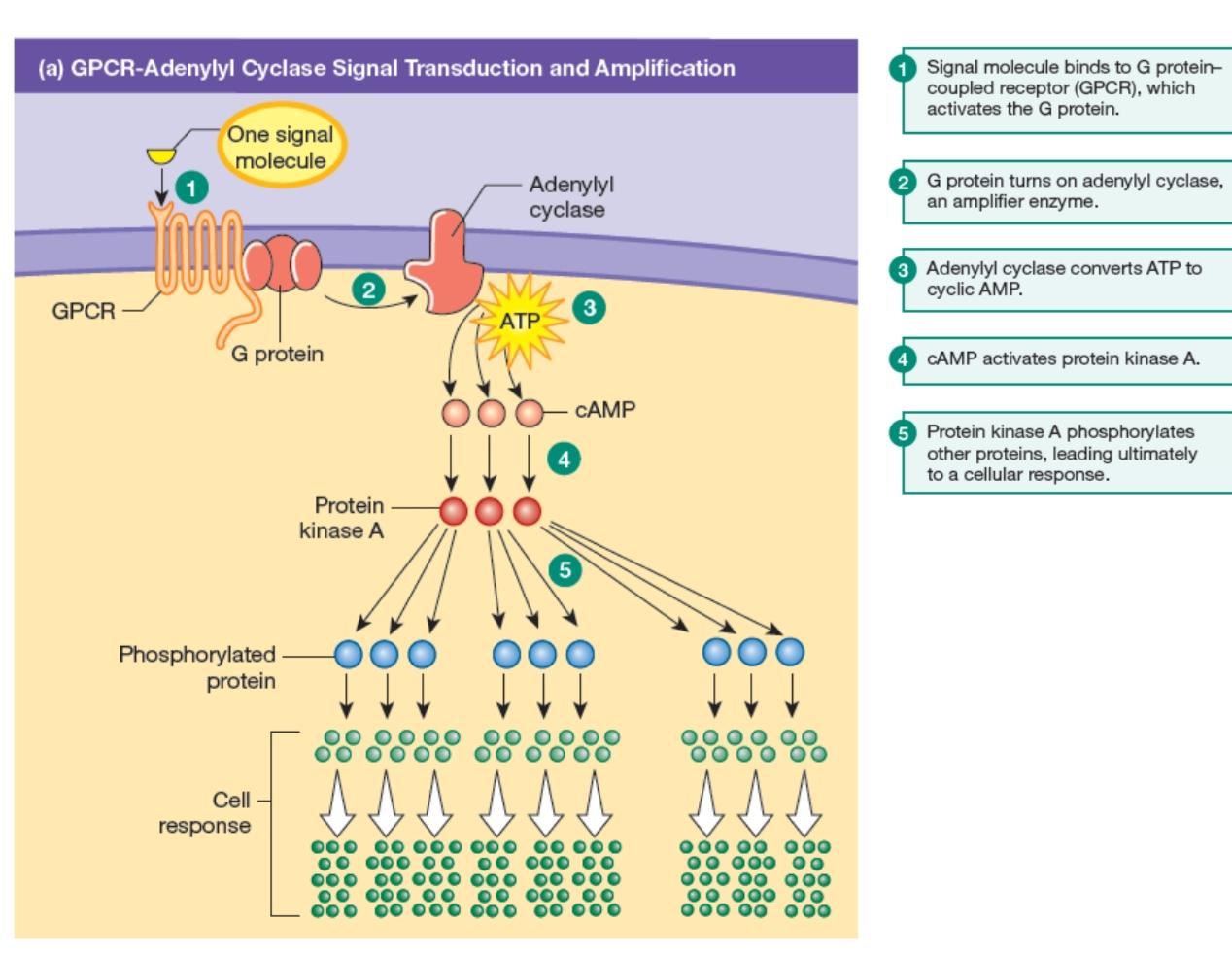
Modulation of signaling pathways
Target cell response - determined by receptor or its associated intracellular pathways
Termination of signaling pathways
Receptor activity can be stopped in different ways:
-
Extracellular ligands degraded by enzymes
- e.g., breakdown of neurotransmitter acetylcholine
-
Chemical messengers transported back into pre-synaptic cells for recycling
- e.g., serotonin reuptake by transporter protein
-
Endocytosis of receptor-ligand complex
- Ligand removed, receptors returned to membrane as endocytosis
